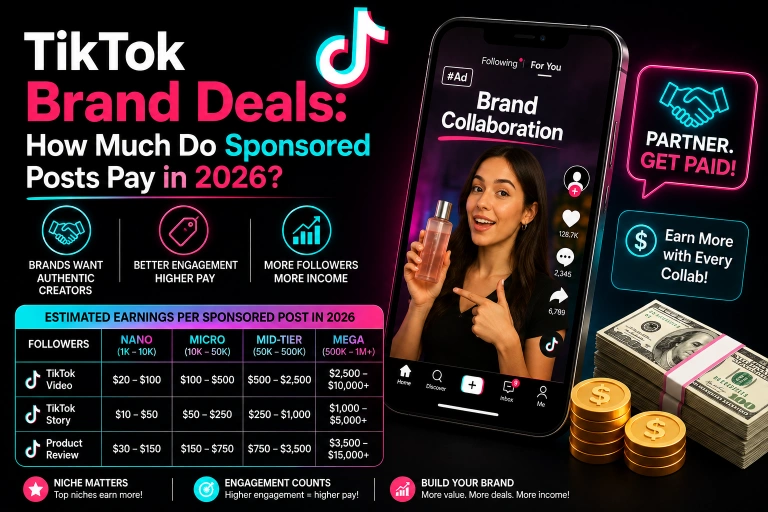
TikTok Brand Deals: How Much Do Sponsored Posts Pay in 2026?
There is no official rate card for TikTok brand deals, which leaves most creators either underpricing out of nerves or overpricing without data to back it up. Here are the real 2026 benchmarks, the formula agencies actually use, and what moves your rate up or down.
How Brand Deal Pricing Actually Works
Unlike Creator Rewards or LIVE gifts, brand deal pricing has no official formula — every rate is negotiated individually. That said, experienced creators and agencies converge on fairly consistent benchmarks once you factor in followers, engagement, and niche together.
Average TikTok Sponsored Post Rates in 2026
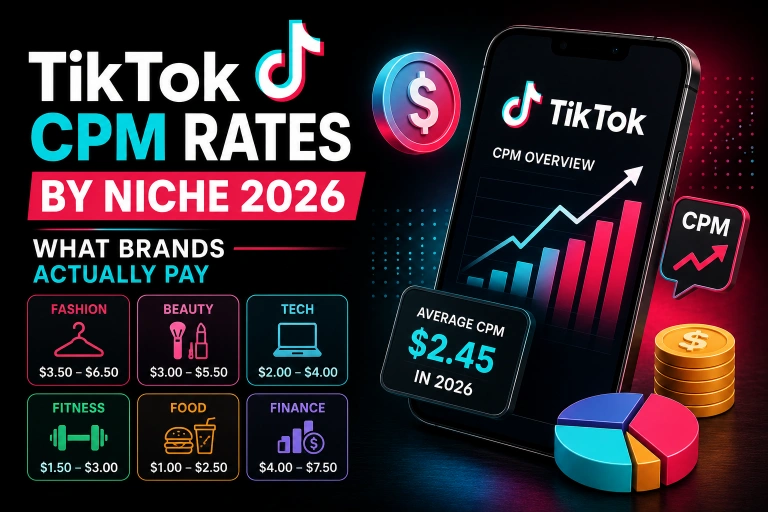
These are blended averages across niches; your specific niche CPM moves the range significantly, as covered in our CPM by Niche guide.
- 10K–50K followers: $100–$400 per sponsored post
- 50K–200K followers: $400–$1,500 per sponsored post
- 200K–500K followers: $1,500–$4,000 per sponsored post
- 500K–1M followers: $4,000–$10,000 per sponsored post
- 1M+ followers: $10,000+ per sponsored post, often negotiated as part of a multi-video package
The Formula Most Agencies Actually Use
A common starting-point calculation is: (followers ÷ 1000) × $10–$30, adjusted up or down based on engagement rate and niche. An account with an engagement rate well above their tier’s benchmark can reasonably push toward the top of that multiplier; an account below benchmark should expect the lower end regardless of follower count.
Worked Examples: The Same Formula, Very Different Quotes
Example 1 — 100K beauty creator, 5% engagement (above her tier’s benchmark): Base: (100,000 ÷ 1,000) × $10–$30 = $1,000–$3,000. Beauty is a high-CPM niche and her engagement sits above benchmark, so she should quote from the top half: roughly $2,000–$3,000 per post. If the brand also wants paid-ad usage rights, that is a separate premium on top — never bundle it into the base post price for free.
Example 2 — 30K fitness creator, 8% engagement (well above benchmark): Base: (30,000 ÷ 1,000) × $10–$30 = $300–$900. His engagement is exceptional for his tier, so he can credibly quote $700–$900 — overlapping the bottom of the 100K range. Now compare a 100K creator at 1.5% engagement (below benchmark): same formula gives $1,000–$3,000, but weak engagement pushes her to the bottom, around $1,000. The follower gap is more than 3x; the realistic quote gap is barely 1.3x. This is why brands increasingly ask for engagement screenshots before follower counts — and why the rate table above is a starting range, not a price list.
Reading the Rate Table by Engagement
Use the tier range, then adjust by where your engagement sits against your tier’s benchmark (see our Engagement Rate Calculator for the benchmarks):
- Below benchmark: expect the bottom quarter of your tier’s range, and focus on lifting engagement before raising rates.
- At benchmark: the middle of the range is a fair quote.
- Above benchmark: the top half of the range is defensible, and in a high-CPM niche you can push past it with proof (screenshots of average views and engagement, not just follower count).
What Actually Moves Your Rate Up
- Above-average engagement rate for your tier. This is the single biggest lever — brands increasingly ask for engagement screenshots before follower counts.
- A high-CPM niche. Finance, tech, and beauty creators can charge noticeably more than entertainment creators at the same follower count.
- Usage rights and exclusivity terms. Granting a brand rights to reuse your content in their own ads, or agreeing to a category exclusivity period, both justify a higher rate.
- A media kit with real performance data. Creators who show average views, engagement rate, and audience demographics close deals faster and at higher rates than those who negotiate on follower count alone.
What Brands Ask For Before They Pay
Before a brand names a number, expect to be asked for:
- Average views on your last 10–15 videos (not your best video, and not your follower count — brands buy views, not followers).
- Engagement rate screenshots from your analytics, by views and by followers.
- Audience demographics: top countries, age ranges, and gender split. A beauty brand wants to know your audience actually buys beauty products.
- Past brand work: 2–3 examples with results if you have them (“this video drove X views and Y comments” beats “I worked with brands”).
Your media kit should contain exactly these four things on one or two pages. A 10-page deck nobody reads is worse than a one-page kit with real numbers.
Negotiation Playbook
- Anchor above your target. Brands expect the first quote to be negotiated down (see FAQ below), so quoting your walk-away number first leaves you nowhere to go.
- Never quote before knowing the full ask. One organic post, usage rights for paid ads, a 3-month exclusivity window, and two rounds of revisions are four different prices, not one. Get deliverables, usage, exclusivity, timeline, and revisions in writing before you name a figure.
- Price packages, not just posts. A 3-video package or a monthly retainer (for example 4 posts a month at an agreed per-post rate, with a small discount for the commitment) is steadier income than chasing one-off deals, and brands prefer it because it locks in a creator they trust.
- Ask for a deposit. Many creators ask for 50% upfront, especially with a new brand. It filters out non-serious enquiries and protects you if the brand goes quiet after delivery.
- Cap revisions. One or two revision rounds in the agreement prevents endless re-edits. Extra rounds are billable.
Red Flags: Deals to Walk Away From
- Product-only payment for a large account. Free product is not payment once your audience has real value — unless you genuinely want the product and the deliverable is tiny.
- Unlimited usage, forever, for the base price. Usage rights are a separate asset. “We can use it anywhere, forever” should come with a separate fee and a time limit.
- Exclusivity without pay. Agreeing not to work with competitors for months costs you other deals. Exclusivity must be paid for, and time-boxed.
- Net-60+ payment with no deposit. Long payment terms plus no upfront money means you carry all the risk.
- Vague deliverables. “Just post something nice” with no agreed video count, format, date, or approval step is how disputes start. Get it in writing.
Contract Checklist (Before You Post)
Deliverables (how many videos, what format) · Posting date window · Revision rounds · Usage rights (where the brand may reuse it, and for how long) · Exclusivity (category + duration) · Payment (amount, schedule, method) · Disclosure (#ad or equivalent, as platform rules require) · Cancellation terms (including a kill fee if the brand cancels after you have filmed). If any of these is missing, ask for it before filming — not after.
Brand Deals vs. Creator Rewards vs. LIVE: Where They Fit Together
Brand deals are the highest-ceiling income stream but the least predictable — you might have zero one month and $3,000 the next. Creator Rewards, detailed in our Creator Rewards Program guide, provides a steadier baseline tied directly to your posting consistency. LIVE gifts, covered in our Live Gifts to Cash guide, add a third income layer that scales with real-time audience loyalty rather than reach. Most full-time creators treat brand deals as the growth lever and the other two as the floor.
Common Pricing Mistakes New Creators Make
- Undercharging to “get the deal.” Low first rates are hard to raise later since brands anchor to your previous rate.
- Not asking about usage rights before quoting a price. A rate that’s fair for a single organic post is too low if the brand plans to run it as a paid ad.
- Quoting a flat rate regardless of follower count changes. Rates should be revisited every few months as your audience and engagement shift.
Not sure where your account currently sits? Get a full picture of your earning potential across every income stream with our TikTok Money Calculator.
How to Find Brands (Without Waiting to Be Discovered)
Create a media kit, identify 20–30 aligned brands, pitch via email or DM. Start with smaller brands. Expect roughly 1 in 10 to respond. Consistency beats waiting to be discovered. A pitch that works is short: two lines of audience proof (followers, average views, engagement), one line on why this brand fits your audience, your rate range, and a clear next step (“open to a 15-minute call next week?”). Attach the media kit; do not paste 10 screenshots into the email body.
Frequently Asked Questions
Should I charge per post or per campaign?
Per-post pricing is simpler for one-off deals; campaign or retainer pricing (multiple posts over weeks) usually works out better for both sides on longer collaborations and is worth offering a modest discount for.
Do brands expect a media kit?
Most mid-size and larger brands do, even if they don’t explicitly ask — having one ready signals professionalism and speeds up negotiation.
Is it normal for brands to negotiate the first quote down?
Yes, this is standard — many creators quote slightly above their target rate specifically to leave room for negotiation.
How much should I charge for my first brand deal?
Use the formula above as your anchor, then be honest about your size: a first deal at the lower-middle of your tier’s range with a brand you genuinely like is worth more than holding out for top dollar and getting nothing. Your second deal can be priced higher with the first as proof.
Should I accept product-only payment?
Only if you genuinely want the product and the work is small (one short mention, not a dedicated video with usage rights). Once your account has real reach, your time and audience are the product — price them.
How do I price usage rights?
As a separate line item, not a free add-on. Price depends on where the brand will run it (their own socials vs paid ads), and for how long. Paid-ad usage commands the highest premium. Put the scope and duration in writing.
What if a brand ghosts me after I deliver?
This is what the contract and deposit are for. With 50% upfront and written deliverables, you are protected for at least half, and you have a paper trail for the rest. Without either, chasing payment is far harder — which is why the checklist above comes before filming, not after.
Disclaimer: All figures are estimates based on 2026 benchmarks published on this site. Actual deal rates vary by niche, engagement, audience geography, usage terms, and negotiation. Nothing here is a guarantee of income.
Written and reviewed by Salman Akhtar · Last updated: November 2026
One Comment
Comments are closed.