
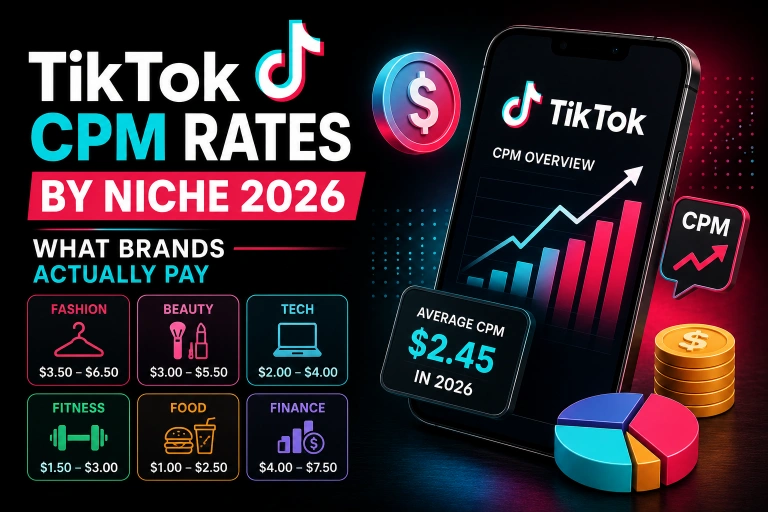
TikTok CPM Rates by Niche 2026: What Brands Actually Pay
Two creators with identical view counts can earn wildly different amounts from TikTok’s ad revenue share, and the reason almost always comes down to CPM. Here is what advertisers actually pay by niche in 2026, why the gap is so large, and how to raise your effective rate without abandoning your content style.
What CPM Actually Means for TikTok Creators
CPM stands for cost per mille — the amount an advertiser pays for every 1,000 views an ad receives. On TikTok, your effective CPM determines how much of that ad spend flows back to you through Creator Rewards and any direct brand placements. Two creators with identical view counts can have wildly different CPMs depending entirely on their content niche.
CPM vs RPM: The Number You Actually Get Paid
Think of it as a chain with three links:
- Advertiser CPM — what the brand pays TikTok for 1,000 ad views.
- Qualified views — the views TikTok actually counts for payout (see below).
- Creator RPM — what lands in your Creator Rewards balance per 1,000 qualified views.
The gap between link 1 and link 3 is TikTok’s platform share plus the filtering in link 2. That is why a finance niche with an $8–$15 advertiser CPM pays creators roughly $0.80–$1.50 per 1,000 views, not $8–$15. Neither number is wrong — they measure different ends of the same transaction. Any calculator that shows you only the advertiser CPM as “your earnings” is misleading you. Our calculators always show the creator-side range.
Average TikTok CPM by Niche in 2026
Advertiser demand varies enormously by category, which directly shapes what you earn per 1,000 views:
| Niche | Advertiser CPM | Creator RPM (approx.) | Why it pays this way |
|---|---|---|---|
| Finance & Investing | $8–$15 | $0.80–$1.50 | Highest-paying niche — a viewer who opens a brokerage account is worth thousands in lifetime value to advertisers |
| Tech & Software | $6–$12 | $0.70–$1.30 | B2B and SaaS advertisers pay a premium for qualified tech audiences |
| Beauty & Skincare | $5–$10 | $0.60–$1.20 | Strong e-commerce advertiser demand year-round, plus high TikTok Shop conversion |
| Health & Fitness | $4–$9 | $0.60–$1.10 | Consistent demand, spikes around January and summer |
| Food & Cooking | $3–$7 | $0.50–$1.00 | High engagement but more competition from other lifestyle content |
| Gaming | $2–$6 | $0.40–$0.80 | Huge audience volume offsets a lower per-view rate |
| Comedy & Entertainment | $1.50–$4 | $0.30–$0.60 | The largest audience pool but the lowest advertiser targeting value |
Run your own numbers through our CPM Calculator to see where your content niche places you.
Worked Example: Same 1 Million Views, Two Niches
All figures below are illustrative, built only from the ranges published on this page and our calculator. Real payouts also depend on watch time, audience country, and how many of those views TikTok counts as qualified.
Finance creator — 1,000,000 views, mid-range rates:
- Advertiser spend at $12 CPM: 1,000 × $12 = $12,000 of ad value around that content
- Creator Rewards at $1.25 RPM: 1,000 × $1.25 = $1,250
- The creator keeps roughly a tenth of the advertiser-side value through Creator Rewards alone — brand deals and TikTok Shop sit on top of this, which is why the full income picture in our Money Calculator is much larger than Rewards alone.
Comedy creator — 1,000,000 views, mid-range rates:
- Advertiser spend at $2.50 CPM: 1,000 × $2.50 = $2,500
- Creator Rewards at $0.45 RPM: 1,000 × $0.45 = $450
Same view count, nearly 3x difference in Creator Rewards — and the finance creator’s brand deals will typically price higher too, widening the gap further. This is why “how many views did you get” is the wrong first question; “who watched, and in which niche” matters more.
Why CPM Varies So Much by Niche
Advertisers bid based on what a viewer is worth to them long-term, not just the click itself. A viewer watching finance content might eventually open a brokerage account worth thousands of dollars in lifetime value, while a viewer watching a comedy skit represents a much smaller and harder-to-track purchase intent. This is the same dynamic that shapes engagement-driven pricing across the platform.
Audience country moves the number too. Advertisers pay considerably more to reach viewers in higher-income markets (US, UK, Canada, Australia and similar) than in lower-income ones, because the expected purchase value per viewer is higher. Two creators in the same niche can therefore sit at opposite ends of the same CPM range purely because of where their audience lives. If your analytics show a heavily US/UK audience, expect the top half of your niche’s range; a mostly international audience trends toward the bottom half. These are directional tendencies, not guarantees — TikTok does not publish an exact country multiplier.
Seasonality matters as well. CPMs across nearly every niche rise in Q4 (October through December) as advertisers increase holiday spending, then dip in January and February. A December video and a February video with identical views will not earn the same amount.
Can You Change Your Niche’s CPM?
Not directly, but creators regularly increase their effective CPM without abandoning their core content by:
- Adding a finance or tech angle to existing content. A cooking creator covering “grocery budgeting” or a gamer covering “best value gaming laptops” blends a lower-CPM niche with a higher-CPM one.
- Targeting a higher-income audience segment. Content framed around premium products or professional audiences tends to carry higher CPM even within the same broad niche.
- Diversifying beyond ad revenue alone. Combining Creator Rewards with LIVE gifts and brand deals — covered in our Live Gifts to Cash guide — reduces how much any single CPM ceiling limits your total income.
- Raising watch time and completion rate. Creator Rewards weighs originality, watch time, and search value alongside raw views. A 90-second video watched to the end earns better than a 65-second video swiped away at 10 seconds, even in the same niche — because more of its views survive as qualified views.
- Making content searchable. Videos that answer a question people actually search for (“how to budget groceries”, “best budget laptop 2026”) keep earning views for weeks, while trend-chasing videos spike and die in 48 hours. Search value is one of the few levers that raises your effective rate without changing your niche.
CPM vs. Creator Rewards: How They Actually Connect
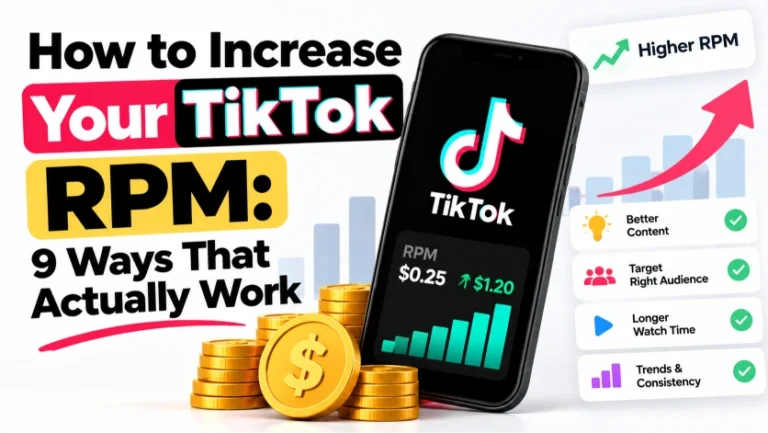
CPM is the advertiser-facing number; Creator Rewards is what TikTok pays you based on a share of that ad revenue combined with watch time and originality signals. A high-CPM niche with poor watch time can still underperform a lower-CPM niche with excellent retention. For the full breakdown of how TikTok calculates your actual payout, see our Creator Rewards Program guide.
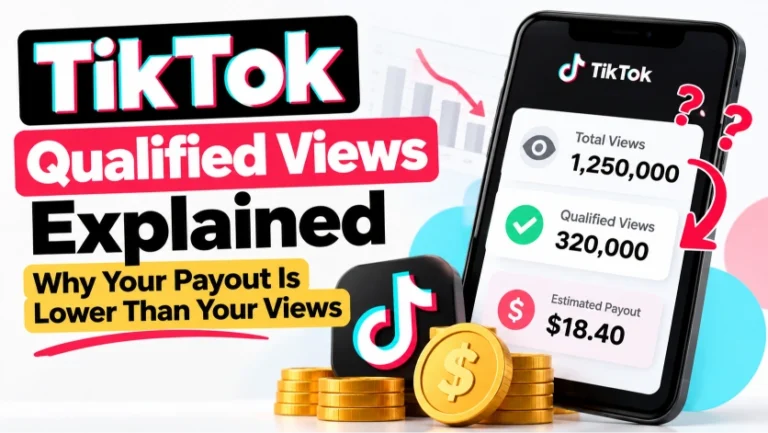
The bridge between the two numbers is the qualified view. Only views that meet TikTok’s rules count toward Creator Rewards: original videos at least 60 seconds long, watched for at least 5 seconds, from the For You feed, passing TikTok’s fraud and quality filters. Repeat views from the same account, views under five seconds, and views TikTok flags as inauthentic are excluded. Your analytics view count will almost always be higher than your qualified view count — which is another reason creator payouts look “lower” than the CPM tables suggest.
Common Mistakes Creators Make With CPM
- Quoting the advertiser CPM as your income. $12 CPM does not mean $12 per 1,000 views in your pocket. Use the creator RPM range for income planning.
- Chasing the highest-CPM niche blindly. Finance pays more per view, but it is also harder to grow in, and a small finance audience can earn less than a large comedy audience. Total earnings = rate × volume × engagement.
- Comparing TikTok CPM to YouTube CPM directly. YouTube pays $1.00–$5.00+ RPM because its ads and watch patterns differ; the platforms monetize differently, and a creator’s best move is often TikTok for discovery plus YouTube for monetization.
- Ignoring watch time. Two creators in the same niche with the same views can earn very different amounts if one holds viewers to the end and the other loses them in the first seconds.
- Trusting a single-number calculator. Any tool that gives one exact figure for “your earnings” is hiding its assumptions. Ranges with explained inputs — like ours — are the honest version.
Frequently Asked Questions
Does CPM change seasonally?
Yes — CPMs across nearly every niche rise in Q4 (October through December) as advertisers increase holiday spending, then dip in January and February.
Is a higher CPM always better for creators?
Not necessarily on its own — a lower-CPM niche with a much larger, highly engaged audience can still out-earn a higher-CPM niche with a small audience. Total earnings depend on CPM multiplied by view volume.
Can I see my actual CPM in TikTok’s analytics?
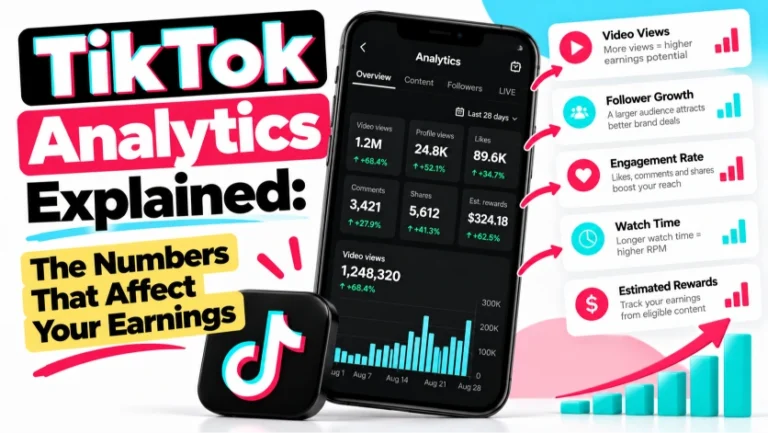
TikTok does not display a literal CPM figure to creators directly; it’s typically estimated by dividing your Creator Rewards earnings by your total views and multiplying by 1,000.
Why is my RPM lower than my niche’s CPM?
Because they are different numbers: CPM is what advertisers pay TikTok, RPM is what TikTok pays you after its share and after filtering for qualified views. The gap is normal, not an error in your account.
Does audience country change my CPM?
Yes, directionally. Audiences in higher-income advertising markets command higher rates; the same niche with a mostly US/UK audience typically earns toward the top of its range.
How often do CPM rates change?
Continuously — advertiser demand shifts with seasons, trends, and budgets. Treat any CPM table, including this one, as a current snapshot: we review these ranges when TikTok changes its programs, and this page shows its last-updated date.
Curious what your content is actually worth right now? Get an instant estimate with our free TikTok Money Calculator.
Disclaimer: All figures are estimates based on TikTok monetization benchmarks as of November 2026 and the ranges published on this site. Actual earnings vary by audience geography, niche, watch time, and program changes. Nothing here is a guarantee of income.
Written and reviewed by Salman Akhtar · Last updated: November 2026


4 Comments
Comments are closed.